On 18 November 2026, the fourth session of the Gender Lab Lunch Talks – Research with Responsibility series will take place online, focusing on the topic "Promises and Risks of AI in Gender Studies".
The session will feature Professor Cláudia Casimiro, Professor Bernardo Coelho and PhD candidate Clarissa Godoy, who will share their knowledge, strategies and experiences regarding the impact of Artificial Intelligence (AI) on the production, organisation, transformation and acquisition of knowledge in the field of Gender Studies.
We invite the entire academic community to join this discussion on the ongoing paradigm shift in the relationship between knowledge, thinking and practice, encouraging collective reflection on the analytical, methodological and authorship-related implications that the use of these new tools raises for Gender Studies.
To join the session, please access the following link.
Meeting ID: 398 735 834 375 422
Passcode: Sy6nz97M
Two research projects developed within CIEG have been awarded funding by the Foundation for Science and Technology (FCT), under the 2025 Call for Research and Development Projects in All Scientific Domains. Together, the two initiatives have secured approximately €265,000 in funding, across the Scientific Research and Technological Development Projects (IC&DT) and Exploratory Research Projects (PEX) categories.
These approvals are particularly noteworthy given the funding recommendation rates recorded in the Social Sciences, which stood at 11.9% for the IC&DT category and 15.5% for the PEX category. The research projects address two contemporary issues relevant to Gender Studies: the relationship between the reconfiguration of masculinities and far-right populism in Portugal, and the role of digital narratives in shaping perceptions of South Asian migrant women.
IC&DT Project | Duration: 36 months
Coordinated by Bernardo Coelho, this project aims to understand the intersections between the reconfiguration of masculinities and the rise of far-right populism in Portugal. The research seeks to analyse how gender-related grievances and historically entrenched forms of resentment intersect in the construction of exclusionary political positions.
The research team also includes researchers Patrícia Neca and Teresa Janela Pinto, with Anália Torres participating as a consultant.
PEX Project | Duration: 18 months
Coordinated by Maria João Cunha, the DINAMISA project focuses on the influence of digital narratives in shaping public perceptions of South Asian migrant women in Portugal, particularly among young adults. The research examines how digital news media and highly engaged online publications contribute to the construction and circulation of representations of these women.
The research team brings together researchers from the Centre for Public Administration and Public Policies (CAPP/ISCSP-ULisboa) and CIEG, namely Carla Cruz, Catarina Reis de Oliveira, Célia Belim and Joana Topa. The project also involves representatives from the Portuguese Regulatory Authority for the Media, the Professional Training Centre for Journalists, the Portuguese Society for Health Literacy, and Inevitável e Fundamental, Lda. Anália Torres also participates in the project as a consultant.
The approval of these two projects strengthens CIEG’s contribution to the production and dissemination of scientific knowledge in the field of Gender Studies, promoting research into contemporary social, political and communication dynamics.
Follow CIEG’s channels to discover the findings of these research projects and learn more about its ongoing work!
IV CIEG International Congress
3 and 4 June 2027
Knowledge in Action: Gender Equality, Human Rights and Democracies at Risk
Gender, Feminist and Women's Studies constitute a field of knowledge that is critical and relevant, characterised by heterogeneity, driven by questioning and oriented towards social impact. Much of the research produced has contributed to significant advances in the fields of Gender Equality and Human Rights, transforming contemporary societies and power hierarchies. The growing visibility and gains achieved in the field of equality are, paradoxically, accompanied by strong reactions from people who feel challenged or threatened by these changes and developments.
The complex coexistence of progress and setbacks in Human Rights on a global scale has been a key theme over the past decade, reflected since 2016 in the programmes and publications of the CIEG International Congresses.
In many countries, the 'Polycrisis' (Tooze, 2022) or the intertwining of observed economic, social, ecological and geopolitical crises has precipitated a profound redefinition of the ways in which knowledge is produced, circulated and legitimised. These successive and simultaneous crises have been exacerbated by global phenomena, such as the pandemic outbreak and recent armed conflicts, resulting in worsening inequalities and living conditions, with real and direct impacts on access to knowledge and its production.
We are also witnessing the growing reconfiguration of the public sphere through the expansion of digital technologies and social media, which intensify phenomena such as polarisation, disinformation and fragmentation of the public sphere. The emergence of regimes shaped by information flows, which privilege emotion and instant consumption, tests the quality of democracies and has consequences for the conditions under which critical debate and 'communicative action' (Habermas, 2012) take place.
The deepening tensions between scientific knowledge, public opinion and political decision-making have particularly affected the field of Gender, Feminist and Women's Studies, which is frequently targeted by political instrumentalisation, media simplification, conspiracy theories, or disinformation campaigns and delegitimisation of research findings and scientific evidence. In different countries, including the United States, the production and dissemination of knowledge have been subject to institutional and/or political restrictions through funding cuts, curricular constraints, and even the closure of academic courses and programmes. The persistence of these attacks, which have already been extensively documented, compromises the possibilities for public dialogue, democratic debate and even the courage to 'speak truth to power'.
Understanding the place of Gender, Feminist and Women's Studies within a contested public sphere requires us to continue systematically questioning who produces knowledge, who legitimises it, who communicates it and, fundamentally, who is heard.
In this fourth edition of the CIEG International Congress, we focus on “Knowledge in Action”, seeking to mobilise the fruitful articulation between academic research, public policies and social interventions in the defence and reinvention of contemporary democracies. The Interdisciplinary Centre for Gender Studies invites researchers from different disciplines and geographical contexts to submit proposals that contribute to advancing knowledge on social inequalities, gender equality, and the threats and challenges facing human rights and democracies.
We welcome contributions that promote critical, intersectional and interdisciplinary reflection on the relationships between knowledge, action and social transformation; present evidence on struggles for rights and better living conditions; and analyse transformations in the quality of democracies in the current context of polycrisis. Contributions presenting research findings in Gender, Feminist and Women's Studies are expected to address at least one of the following themes:
Democracies at Risk: Resist, Reinvent, Act
· Human rights, contemporary threats and forms of resistance
· Gender equality public policies: progress, setbacks and reconfigurations
· Gender-based violence: between human rights, public policies and contexts of crisis
· Anti-gender narratives, conservatisms and ideological disputes
· Gender, peace and armed conflicts
· Global justice, coloniality and power relations
Knowledge in Dispute: Gender, Power and Freedoms
· Gender, Feminist and Women's Studies and power relations
· Science, disinformation and public contestation of knowledge
· Feminist and Queer epistemologies and methodologies
· Education, citizenship and curricula under debate
· Artificial intelligence and gender inequalities
Precarity, Gender Inequalities and Social Justice
· Work, employment, precarity and the political economy of gender
· Poverty, housing and social inequalities
· Migration, gender and human trafficking
· Gender, territory, environment and ecological justice
· Intersectionalities and structural inequalities
· Diversity, disability and citizenship
Sexualities, Diversity and Identities: Plural Existences
· Sexual rights and reproductive justice
· LGBTQIA+ recognition and rights
· Bodies, health and well-being
· Sexualities, affect and identities
· Racialisation, voice and representation
· Gender-based violence: practices, power and resistance
· Transformation of intimate relationships, families and parenthood
Public Sphere, Cultural and Artistic Production, and Symbolic Power
· Artistic and cultural production: visibility, narratives and disputes
· Public sphere and information governance: power, control and mediation
· Gender, media and journalism
· Hate speech and online violence
· Artivism: artistic and political practices
Submission Guidelines
Communication proposals should contain a maximum of 300 words. Each person may submit a maximum of 2 abstracts as first author.
Languages accepted at the Congress: Portuguese, English and Spanish.
Important Dates:
15 November 2026 – Deadline for submission of communication proposals.
15 January 2027 – Deadline for notification of acceptance/rejection of proposals.
28 February 2027 – Deadline for registrations at the reduced (early bird) rate.
30 April 2027 – Deadline for registration of participants with accepted proposals. Participants who have not registered by this date will not be included in the Congress programme.
Registration amounts:
|
Category |
Early bird (until 28 February 2027) |
After 30 April 2027 |
|
Standard |
250 € |
300 € |
|
Student |
90 € |
140 € |
|
Low- and lower-middle-income countries |
170 € |
220 € |
Proposal submission platform available here
Event Venue:
Instituto Superior de Ciências Sociais e Políticas da Universidade de Lisboa
Rua Almerindo Lessa, 1300-663 Lisboa
Contacts: This email address is being protected from spambots. You need JavaScript enabled to view it.
Maria João Cunha, Director of CIEG, has been appointed by EUPRERA to lead the Women in Public Relations Network.
The network is dedicated to advancing research on women, gender, and public relations by fostering dialogue and collaboration among researchers across different national and professional contexts.
This appointment further strengthens CIEG's presence in international scientific networks and reflects its ongoing commitment to the production and dissemination of knowledge in the fields of gender studies, communication, and public relations.
Read more in EUPRERA's announcement:
https://euprera.org/2026/07/06/leadership-transition-euprera-women-in-public-relations-network/
Within the framework of the Marie Skłodowska Curie Actions Postdoctoral Fellowships under Horizon Europe, the CIEG – Interdisciplinary Centre for Gender Studies welcomes expressions of interest from researchers wishing to apply to the Marie Skłodowska-Curie Actions (MSCA) Postdoctoral Fellowships 2026 with CIEG as the host institution.
The MSCA Postdoctoral Fellowships support excellent researchers undertaking innovative research projects while advancing their international mobility, interdisciplinary experience, and career development.
The deadline for submitting expressions of interest to CIEG has been extended to 17 July 2026.
Researchers interested in applying with CIEG as the host institution are invited to submit an expression of interest by 17 July 2026 to This email address is being protected from spambots. You need JavaScript enabled to view it. (Subject: "Expression of Interest – MSCA Postdoctoral Fellowships 2026").
Applications should include:
Proposed work plans are expected to fit within at least one of CIEG’s ten Research Themes (RT)
Applicants are encouraged to consult CIEG’s research activities and scientific outputs before submitting their proposal.
Please note that incomplete expressions of interest will not be considered. The final decision regarding institutional support and the hosting of proposals will be made by CIEG.
Deadline for submission to the Horizon Europe Funding & Tenders Portal:
9 September 2026 (17:00 Brussels time)
https://ec.europa.eu/info/funding-tenders/opportunities/portal
More information about the programme is available at:
https://marie-sklodowska-curie-actions.ec.europa.eu/funding/msca-postdoctoral-fellowships-2026
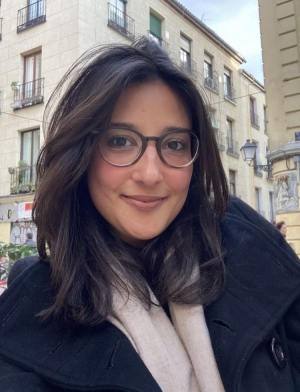
Clarissa Godoy is a PhD candidate in Gender Studies at ISCSP/University of Lisbon, with a research grant from the FCT (Foundation for Science and Technology), and the Interdisciplinary Centre for Gender Studies (CIEG) as her host institution.
She holds a Master’s degree in History from the Federal University of the State of Rio de Janeiro (UNIRIO), with the thesis “Woman on Scene: The Series Malu Mulher and the Possibilities of Feminisms in the Brazilian Civil-Military Dictatorship (1979/1980)” (2016–2018). She also holds a Bachelor’s degree in History from the Federal University of Rio de Janeiro (UFRJ) (2011–2015).
She founded "Fronteiras do Saber" (Instagram, 2020–2022), an educational project that promotes gender equality from a feminist perspective, where she also served as a teacher.
She acts as a peer reviewer for academic journals such as InterAção (UFSM), Time, Space and Language – TEL, and Revista Oré.
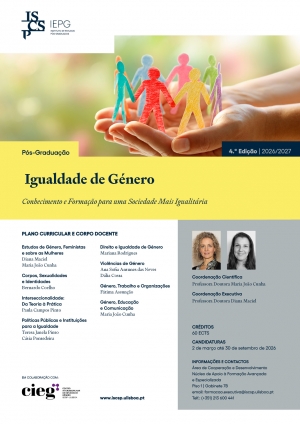
Applications are now open for the 4th Edition of the Postgraduate Program in Gender Equality – Knowledge and Training for a More Equal Society, for the 2026/2027 academic year.
Application Periods
1st Phase: March 2nd to June 30th, 2026.
2nd Phase: July 1st to September 30th, 2026.
Program Coordination
Scientific Coordination: Professor Maria João Cunha.
Executive Coordination: Professor Diana Maciel.
Information and Contacts
For administrative inquiries and enrollment, please contact the Center for Advanced and Specialized Training Support:
E-mail: This email address is being protected from spambots. You need JavaScript enabled to view it..
Phone: (+351) 213 600 441.

Joana Teixeira holds a PhD in Sociology from the University of Minho, supported by an FCT (Foundation for Science and Technology) scholarship. She also holds a Master’s degree in Sociology with a specialization in Social Policy from the same institution, and a Bachelor’s degree in Social Work from the University of Taubaté. She has experience in scientific research in the areas of gender studies, violence, inequalities, and social policies.
Contact:
This email address is being protected from spambots. You need JavaScript enabled to view it.
Ciência ID: A51A-BDD8-DC60
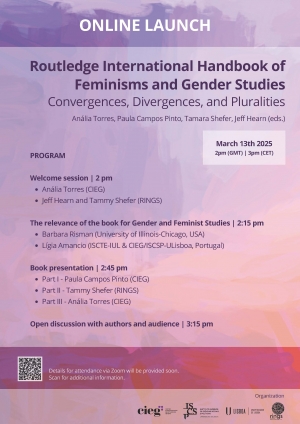
The Interdisciplinary Center for Gender Studies (CIEG/ISCSP-ULisboa) and The International Research Association of Institutions of Advanced Gender Studies (RINGS) invite you to the online launch of the “Routledge International Handbook of Feminisms and Gender Studies. Convergences, Divergences, and Pluralities”, which will take place on Thursday, March 13th 2025.
The 25-chapter volume was edited by Anália Torres, Paula Campos Pinto, Tamara Shefer, and Jeff Hearn. This Handbook offers a unique global perspective in the field of feminist and gender studies, featuring contributions from authors of several different nationalities, including Albania, Argentina, Brazil, Czech Republic, Germany, Iceland, India, Iran, Jordan, Portugal, South Africa, Sweden, Switzerland, Turkey, Uganda, and the United Kingdom.
Join us for the launch session on March 13th at 2pm (GMT) / 3 pm (CET)
Link for attendance here: https://videoconf-colibri.zoom.us/j/96239021176
The event will also be streamed live on CIEG's Youtube Channel, here.
Additional details can be found on CIEG’s website here and RINGS website.
We look forward to seeing you!
Anália Torres
Paula Campos Pinto
Tamara Shefer
Jeff Hearn
News/ Events
CIEG's activities